Chaos on the battlefield isn’t bad luck—it’s failed leadership. A disorganized team hesitates, misfires, and collapses under pressure, turning winnable fights into crushing defeats. This guide confronts that problem head-on by breaking down the core squad command mechanics that transform scattered players into a disciplined, coordinated force. You’ll learn how to issue clear, concise, and confident commands that eliminate hesitation and inspire immediate action. These principles are forged from relentless in-game experience, not theory—built for leaders who understand that victory is engineered through precision, timing, and authority. If you want your team to move as one, this is your blueprint.
The Three Pillars of Command: Clarity, Conciseness, Confidence
I learned this the hard way during a late-night raid when our party wiped—twice—because I yelled, “Someone grab aggro!” No one moved. Everyone assumed someone else would. That single vague sentence cost us the match (and a good chunk of pride).
Clarity
Clarity means structuring a command so it cannot be misunderstood. In practical terms, that’s Subject–Verb–Object: who does what to whom. Instead of “Get the healer,” say, “Rogue, stun the enemy Priest NOW.” You name the actor, define the action, and identify the target. There’s no ambiguity, no hesitation. Real-world militaries use similar direct phrasing to reduce cognitive load under stress (U.S. Army Field Manual 6-0 emphasizes clear, direct orders). In high-pressure games, clarity functions the same way.
Conciseness
In combat, time is a currency you’re constantly spending. Long-winded instructions drain it. I once caught myself saying, “Okay guys, I think we should probably try to focus our damage…” By the time I finished, the window had closed. Now it’s simple: “Focus fire: Ogre Mage.” Conciseness means stripping language to essentials—no filler, no hedging. Every extra syllable is latency (and latency kills).
Confidence
Tone shapes response. A shaky call breeds doubt; a firm one sparks action. Even within squad command mechanics, hesitation spreads like a debuff. I’ve seen a flawed but decisive push succeed because everyone committed instantly. Confidence doesn’t mean arrogance—it means commitment. If morale systems fascinate you, explore the role of morale systems in modern military strategy titles to see how authority impacts outcomes.
Speak clearly. Speak briefly. Speak like you mean it.
Situational Awareness: Reading the Battlefield
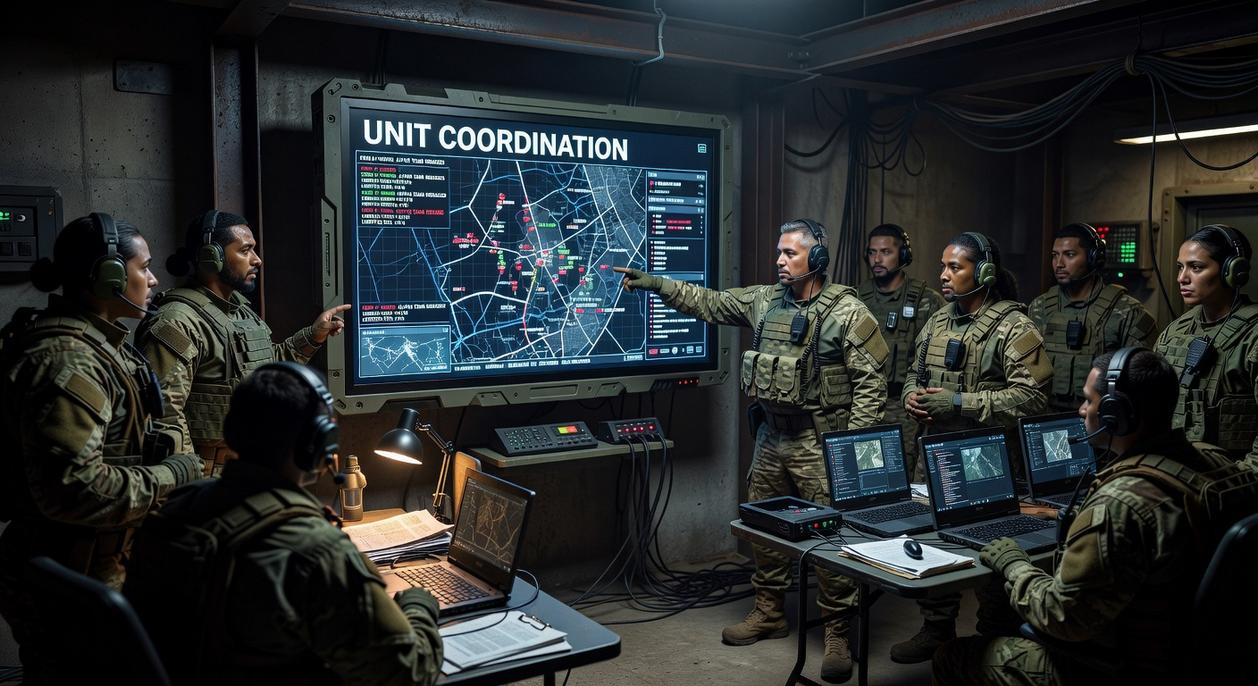
Great leadership in battle is less like barking orders and more like conducting an orchestra. The symphony only works when the conductor understands both the grand composition and the precise cue for the violins.
That’s where Macro vs. Micro Commands come in.
A Macro command is the campaign map. It defines the destination and sets emotional tempo: We’re taking the high ground. It’s the difference between saying “win the war” and explaining how you’ll control supply lines. A Micro command, by contrast, is the snap of the baton: Mage Frost Nova the choke point. It’s immediate, specific, and tactical. Think of Macro as the chess strategy and Micro as the exact move of the knight. One without the other is chaos (or worse, hesitation).
Then there’s the If-Then Protocol—your battlefield insurance policy. Instead of reacting to disaster, you pre-write the script. If the boss starts casting Annihilate, everyone use defensive cooldowns. It’s like a fire drill: no panic, just execution. NFL quarterbacks study defensive formations the same way—if the blitz comes, the ball is already gone. Pro tip: rehearse these scenarios out loud before the fight; clarity now saves wipes later.
Finally, understand that resource management is command. Stamina, mana, ultimates—these are your army’s rations. Save ultimates for the final 20%. Healers, conserve mana until the enrage phase. Winning isn’t about burning bright; it’s about burning longest. Even in The Lord of the Rings, battles turned on endurance, not flashy openings.
Command the vision. Command the moment. Command the fuel.
The Command Toolkit: Pings, Markers, and Voice Comms
In high-stakes matches, communication isn’t a bonus—it’s infrastructure. Voice comms (real-time spoken communication through a headset) remain the fastest and most nuanced tool available. According to a 2017 study published in Computers in Human Behavior, teams using synchronous voice communication completed cooperative tasks significantly faster than text-only groups. That edge shows up in-game when strategies pivot mid-fight. The counterargument? Voice chat can become chaotic and distracting. True—without discipline. Clear channels, concise phrasing, and push-to-talk eliminate clutter (no one needs to hear your mechanical keyboard during a boss pull).
Visual markers—Skulls, Crosses—create instant clarity. In cognitive psychology, this is called attentional cueing: visual signals direct group focus efficiently. Marking a priority target unifies damage output, reducing time-to-elimination. A simple verbal reinforcement—“Attack the Skull”—doubles the signal. Think of it like the glowing weak point on a Dark Souls boss; everyone knows where to strike.
The ping system is the universal language of gaming. Pings transmit spatial intent faster than words alone. Pairing a “Danger” ping with a voice callout increases reaction time because players process both visual and auditory cues simultaneously (a principle known as dual coding theory).
Effective squad command mechanics rely on tool synergy:
- Voice for strategy shifts
- Markers for focus fire
- Pings for precise positioning
Some argue that elite players “just know” what to do without structure. Yet esports case studies consistently show coordinated teams outperform mechanically superior but disorganized opponents. Pro tip: assign one shot-caller to prevent overlapping commands. Clarity wins fights.
Adapting Your Command Style: The Human Element
Know Your Squad
In Dark War Fall raids—whether you’re pushing Blackspire Keep or skirmishing in the Ashen Wastes—your approach has to flex. A tight guild unit that drills weekly can process layered calls like, “Hold choke, bait cooldowns, collapse on mark.” A PUG from global chat? They need: “Stack. Push. Burn.” Clear. Repeatable. No shorthand. (Yes, even if you’ve typed it a hundred times.) Effective squad command mechanics hinge on reading experience levels, gear tiers, and even regional server latency quirks.
• Pro tip: If half the group is under-geared, shorten call chains to three words max.
Giving and Receiving Feedback
After a wipe, ask: “Was that stun late?” Quick answers sharpen timing and build trust. Some argue feedback slows momentum. In reality, 20 seconds of clarity prevents 10 minutes of chaos.
Maintaining Morale
“Bad pull. Reset. Watch patrol.” Replace blame with direction. Teams rebound faster when correction feels tactical—not personal (nobody fights well tilted).
To effectively master squad command mechanics in tactical war games, it’s essential to understand not only your team’s strengths but also how these strategies compare to the popular esports games highlighted in our article on ‘What Are The Popular Esports Games To Play Hcdesports.’
From Commander to Legend: Mastering the Flow of Battle
A silent or chaotic team is a defeated team. When calls are unclear and movements uncoordinated, disorganization becomes the true enemy. If you’ve struggled to control the tempo of battle, you’ve seen how quickly confusion turns into collapse.
True command is forged through Clarity, Conciseness, and Confidence—strengthened by sharp battlefield awareness and executed through disciplined squad command mechanics. These are not abstract ideals; they are practical tools that let you impose order on chaos.
Master them. Drill them. Demand them from your team. Do this, and you won’t just survive the fight—you’ll turn losses into victories and become the leader others trust when the fire is at its hottest.
 Gabrielakina Beeson is the kind of writer who genuinely cannot publish something without checking it twice. Maybe three times. They came to battle strategy insights through years of hands-on work rather than theory, which means the things they writes about — Battle Strategy Insights, Dark-Fantasy Combat Systems, Hot Gaming Topics, among other areas — are things they has actually tested, questioned, and revised opinions on more than once.
That shows in the work. Gabrielakina's pieces tend to go a level deeper than most. Not in a way that becomes unreadable, but in a way that makes you realize you'd been missing something important. They has a habit of finding the detail that everybody else glosses over and making it the center of the story — which sounds simple, but takes a rare combination of curiosity and patience to pull off consistently. The writing never feels rushed. It feels like someone who sat with the subject long enough to actually understand it.
Outside of specific topics, what Gabrielakina cares about most is whether the reader walks away with something useful. Not impressed. Not entertained. Useful. That's a harder bar to clear than it sounds, and they clears it more often than not — which is why readers tend to remember Gabrielakina's articles long after they've forgotten the headline.
Gabrielakina Beeson is the kind of writer who genuinely cannot publish something without checking it twice. Maybe three times. They came to battle strategy insights through years of hands-on work rather than theory, which means the things they writes about — Battle Strategy Insights, Dark-Fantasy Combat Systems, Hot Gaming Topics, among other areas — are things they has actually tested, questioned, and revised opinions on more than once.
That shows in the work. Gabrielakina's pieces tend to go a level deeper than most. Not in a way that becomes unreadable, but in a way that makes you realize you'd been missing something important. They has a habit of finding the detail that everybody else glosses over and making it the center of the story — which sounds simple, but takes a rare combination of curiosity and patience to pull off consistently. The writing never feels rushed. It feels like someone who sat with the subject long enough to actually understand it.
Outside of specific topics, what Gabrielakina cares about most is whether the reader walks away with something useful. Not impressed. Not entertained. Useful. That's a harder bar to clear than it sounds, and they clears it more often than not — which is why readers tend to remember Gabrielakina's articles long after they've forgotten the headline.